As the transcript of my lightning talk at the Museum of Art and Photography (MAP), Bengaluru, this post begins with a note of gratitude to Mounika Nallani, Sushma Rao, and Breanne Coelho of MAP for making the event possible—and an equal set of shout-outs to my panel co-convenor and session moderator Siddharth Narrain (NLSIU); fellow presenters Uma (Jeeva); Manavi Atri (Alternative Law Forum); and Mira Brunner (QAMRA); and everyone who attended the session and made it an engaging and affirming evening. The talks and panel discussion were scheduled on July 13, 2025, and the post title echoes the event title: “From Archive to Activism: Queer and Trans* Cultural Work”.
I want to begin with three images.
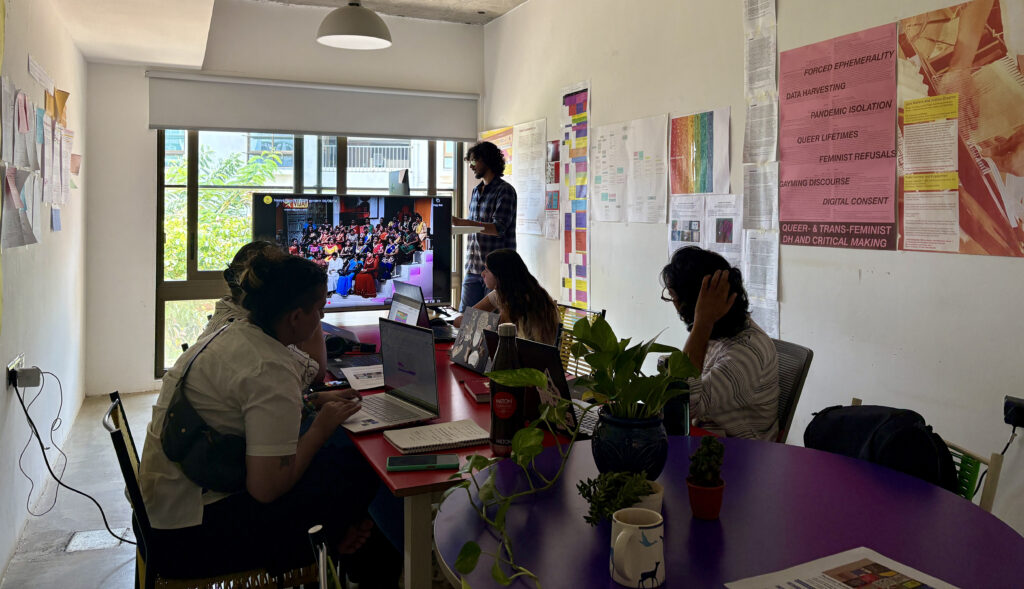
The first image was taken earlier this year in April in the context of a transdisciplinary research cycle at The Just Futures Co-lab. What you see in perspective is the standing figure of one of my students, aṇu, discussing an episode of “Neeya Naana | நீயா நானா,” a recorded television program published on YouTube on June 9, 2014, where thirunangai Sudha talks about “the nature of a thirunangai’s love and the ways in which she loves;” or following aṇu’s annotation, “Sudha describes how a thirunangai can feel like a mother, and be a mother, even though she cannot ‘birth’ a child herself”—and this annotation is an integral part of aṇu’s inquiry entitled “to birth,” where she re-contextualizes the phrase “to birth” to unpack, in her words, “its ties to patriarchal bodily regimes as well as its capacity in world-building, chosen-family-building (as in co-birth) for queer and trans+ peoples, and திருநங்கைகள் (thirunangaigal).” Also in this image, seated at the red table, are four other lab members: Anwesha, eyeshaan, Shae, and Ruhani.
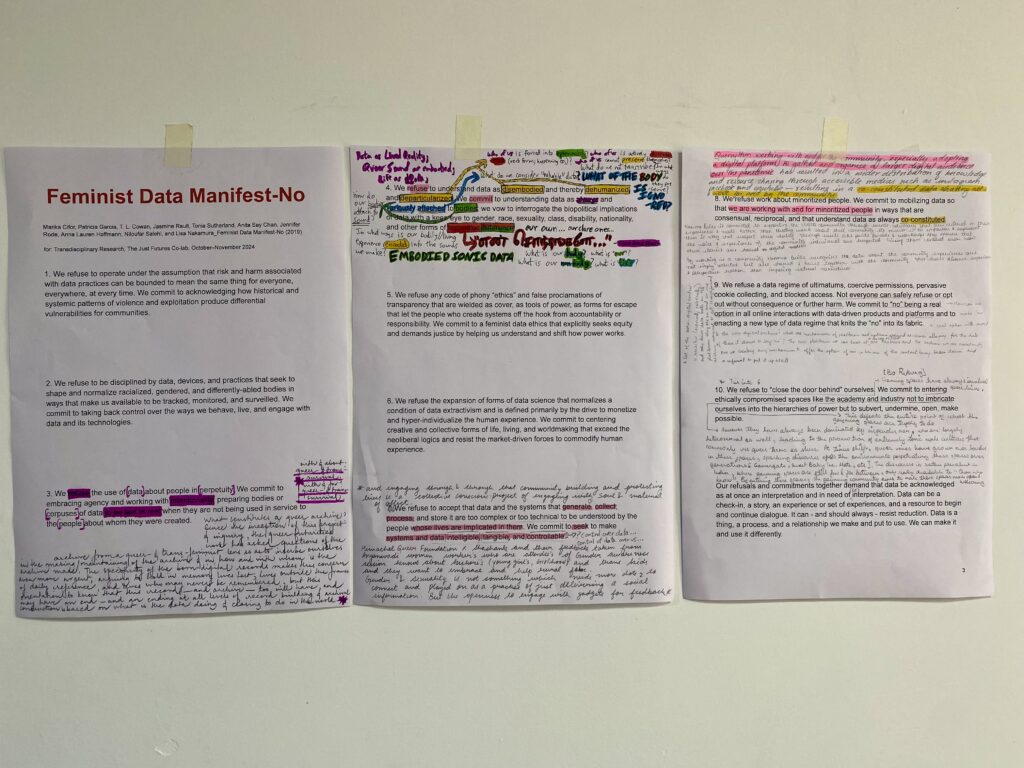
The second image was taken in November of last year. Pinned to the wall of the lab are a set of three prints, laid side-by-side, covering 10 thickly annotated principles of the 2019 Feminist Data Manifest-No project, co-authored by Marika Cifor, Patricia Garcia, TL Cowan, Jasmine Rault, Tonia Sutherland, Anita Say Chan, Jennifer Rode, Anna Lauren Hoffmann, Niloufar Salehi, and Lisa Nakamura. Consider the principle #3, which is to the bottom left of this screen. The principle states, and I read: “We refuse the use of data about people in perpetuity. We commit to embracing agency and working with intentionality, preparing bodies or corpuses of data to be laid to rest when they are not being used in service to the people about whom they were created.”
With this principle, I find myself returning to the question of what constitutes a queer archive? In my annotation, I write: Since the inception of this project space and inquiry, I have asked questions of the archive from a queer- and trans-feminist and an anti-colonial lens as a way to also inscribe myself—and ourselves—into the making and maintenance of the archive, as well as with and for whom the archive is made. The specificity of born-digital archival records (which is also a core area of my research), however, makes this concern urgent, inviting us to hold in memory both known and yet-to-be-known lives: lives lost, lives outside social and digital defaults, lives who may never be remembered or considered worthy of remembering from those social and technological centers, and lives becoming themselves fully in and via the digital. The specificity of born-digital records, additionally, makes this concern important, enabling me to argue that this record—and archive—too will, and should, have an end and an ending at all levels of its construction as we keep in view and remain vigilant about what is the data doing—and what is the data ceasing to do—in the world with any eye toward: queer and trans+ flourishing, queer and trans+ futurity.
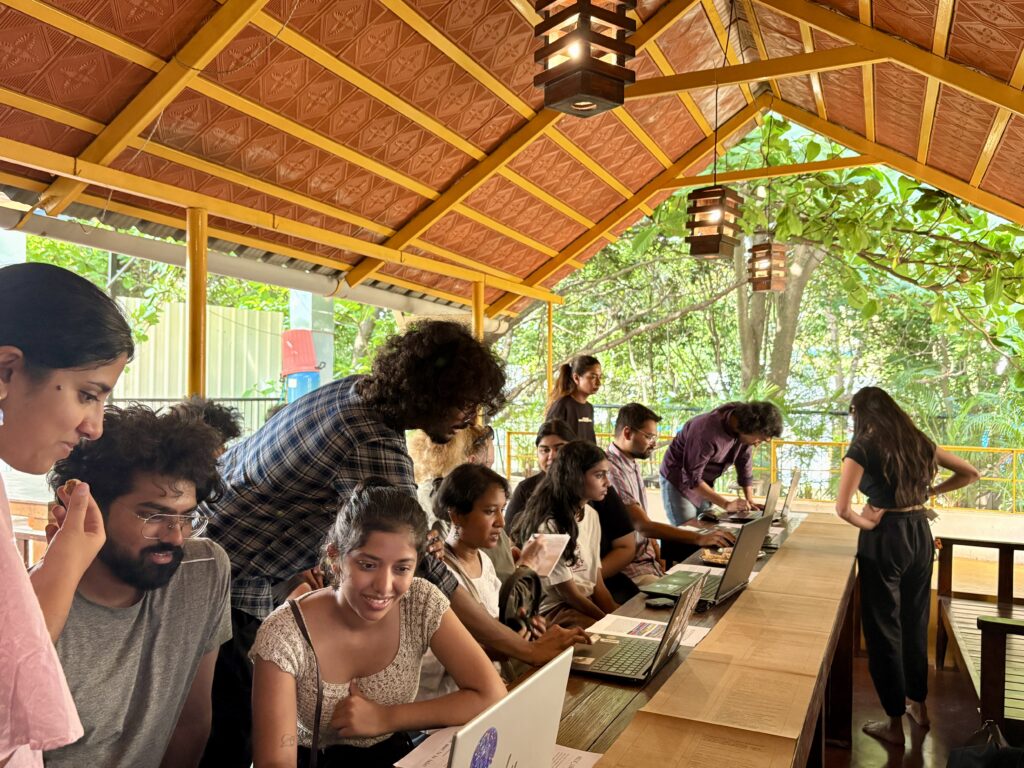
The third image is that of an off-campus pop-up lab from May this year. The view frames individuals engaging with interactive artistic hypertexts on one side and an endless scroll of digital humanities indexes on the other side. Hypertexts are non- or multi-linear pathways through text that offer each reader a deeply personal experience of reading and interacting with that text. Variously titled as “பிறப்பிக்க (to birth)” [by aṇu]; “to author one’s body” [by Anwesha]; “nameless” [by eyeshaan]; “Patterns” [by Ruhani]; and “MILK LOGIC” [by Shae], these computer-based interactions animated each student’s inquiry lines as developed and deepened over five weeks, namely, aṇu on “A Rhizome of Queer and Trans+ Texts, Sounds, Peoples, Images, and Networks;” Anwesha on “Authoring Bodies, Authoring Feminisms;” eyeshaan on “Self-Projections, Trans Records, and Fexyzale Voices;” Ruhani on “Neuro Patterns: A Non Conforming Body in a Conformed World;” and Shae on “Holding the Grotesque Closely—and with Critical Intimacy.”
Together, these images mark my ongoing praxis of building intentional communities of research-creation and keeping alive the questions that Blu Buchanan and I had asked in our 2018 writing on “Dodgy Scholars” or “what might it mean to be hyper-visible or invisible in our collaborative, committed, and transformative university work; how the question of visibility shapes our current practices and perspectives; and how the same question might introduce new ways of developing not just a society of scholar activists, teachers, and hybrid professionals [including archivists and artists], but also a richer commons which sees a subverting of these troubles and siloed professions in our everyday lives” [para 4]. “We are dodgy scholars,” or this is how Blu and I introduced ourselves in this writing: we rupture normative expectations of productivity and scholarly impact by actively working on the frayed edges of a disrupting lab to further research through embodied and situated making reviewed in community. “The tightrope walk of a subversive scholar,” we wrote, “is in the details” [para 3]—and with these details, we claimed the politics of dodging any and all attempts of domestication by the institution.
The Just Futures Co-lab is a space for digital humanities research and teaching—but one that also navigates this question of visibility with care and intention. It is a critical space for critical praxis—an “undercommons,” if you will, to borrow from Fred Moten and Stefano Harney’s work, for queer and trans cultural organizing. Since its inception in 2021, the lab has produced discourse and scholarship on equity and justice through critical pedagogy [consider for example the studios on care matters and justice dreams centering biographical critiques and inquiring into the relationship between coding, weaving, and storytelling] ; archives, bibliographies, and databases [hold in view for example the seminar and transdisciplinary research projects on archives and social justice, foregrounding community resources, ephemera, zines, and anti-caste scholarship]; and interactive digital storytelling [see for example the ongoing process of archiving materials that are exclusively digital with T. Jayashree at QAMRA and inquiring into queer- and trans-feminist digital technologies through critical-making].
Our lab works are multilingual and multi-sited [consider the spread of texts we read in community as part of the Feminist Solidarities Reading Circle in Cubbon Park]; our lab worlds are multi-threaded and plurally mediated [feel the woven gendered critiques of anti-surveillance that artists and scholars like Jaqueline Wernimont have called “data visceralization”]; and our process is structurally slow and archival [consult the spreadsheet of archival description, involving born-digital materials and feminist care work].
Collectively these artifacts and experiences help to bring into view a set of questions that I constantly ask myself and my students: What ethical and political issues become significant when queer and trans+ lives are inscribed in these materials or when such materials have direct consequences for queer and trans everydayness? How might we research images, texts, sound files, and even videos connected to either an event or a period of cultural and technological significance—and what does it mean to verify the authenticity of this material in the age of misinformation and disinformation, and to advocate around its “enduring value” as a record from an archival perspective?
This work, I would argue, is cultural organizing work; it is slow engagement work that challenges the binaries of culture and politics, art and activism, and theory and practice. I come to this work with a background in and an ongoing practice in critical librarianship and the digital humanities connected to the fields of architectural history-theory; contemporary art; feminist, queer, and transgender studies; and critical pedagogy. In this practice, cultural organizing is about analyzing power both critically and creatively towards data and bodily sovereignty; about stewarding a space and knowledge infrastructure for cultural critique and resistance; about actualizing, in bell hooks’s words, “education as a practice of freedom” (Teaching to Transgress, 1994).
The Just Futures Co-lab is a space, a room, and an infrastructure within an institution, but not of that institution; the lab is also a collective, a curriculum, and a trusting bond I build with students and learners across deliberate and diverse campus-community locations. The archive of the monthly letters I write from the lab called “Felt Notes” is one example of demonstrating my praxis, which enable me to not just share the ongoings of our research creations, but also extend the lab into known and soon-to-be-known readers both translocally and transnationally. By sharing with you today a set of works, processes, and tools also brings me to illustrate what cultural organizing can be or what it means to talk back at the colonial trappings of expertise that come with being an academic, artist, or an archivist each with a capital A, especially for those of us grounded in anti-colonial community-centered work—and more importantly, attuned to what care labour is and how it has historically been distributed across sites of knowledge from archives to activism, with archives as activism.
Thank You!